
From early signals to earlier care: advancing COPD monitoring through breath analysis
For people living with chronic obstructive pulmonary disease (COPD), exacerbations can change everything: a sudden worsening of symptoms can lead to emergency visits, hospitalisation, an accelerated decline in lung function, and a lasting impact on quality of life. Despite advances in treatment, doctors and healthcare professionals often remain one step behind, responding to exacerbations only after symptoms have already appeared.
Detecting the earliest signs of an exacerbation before patients experience the first symptoms would significantly change this, shifting COPD care from reactive to proactive.
A recent paper in the Journal of Breath Research brings us closer to that by demonstrating how exhaled breath analysis could help identify COPD exacerbations by detecting biological signals hidden in every breath.
The challenge of monitoring in a dynamic disease
COPD is inherently dynamic. Patients can remain relatively stable for weeks or months before experiencing an exacerbation triggered by infection, inflammation, or other physiological changes. While symptom questionnaires, lung function measurements, and clinical assessments remain essential tools, they often capture changes only after the disease process has already started, therefore creating a critical gap in COPD care.
The earlier clinicians can identify worsening disease activity, the greater the opportunity to intervene, adjust treatment, and potentially prevent severe outcomes. That is why researchers and innovators have increasingly turned their attention to the lungs and, more specifically, to the information contained in exhaled breath.
Every breath tells a story
Human breath contains hundreds of volatile organic compounds (VOCs), small molecules produced by metabolic and inflammatory processes throughout the body. These compounds serve as biological fingerprints, reflecting what is happening beneath the surface long before changes become visible with conventional monitoring methods.
Over the past decade, numerous studies have identified VOCs associated with COPD. However, translating these findings into practical clinical tools requires answering a more pressing question: Which breath markers reliably signal a COPD exacerbation?
To address this outstanding question, researchers from Amsterdam UMC, RespiQ, uRoboptics, and collaborating institutions conducted a comprehensive review and validation study to distinguish promising signals from scientific noise.
From hundreds of compounds to a focused biomarker panel
The research team systematically reviewed the literature on breath biomarkers in COPD, identifying 159 VOCs previously linked to the disease. From this large pool, they selected compounds independently reported by at least two research groups, creating a shortlist of the most robust candidate biomarkers.
As a next step, the researchers focused on validation: using longitudinal breath samples collected from COPD patients during stable disease, exacerbation, and recovery phases, they evaluated whether these biomarkers could reliably distinguish periods of symptom worsening from stable states. The results were highly encouraging: a model based on six validated VOCs differentiated exacerbations from stable disease with 0.97 sensitivity, 0.93 specificity, 94.3% diagnostic accuracy, and an area under the ROC curve (AUC) of 0.98.
These findings suggest that breath-based biomarkers can provide a highly accurate picture of disease status over time and may offer an objective method for identifying exacerbations as they occur.
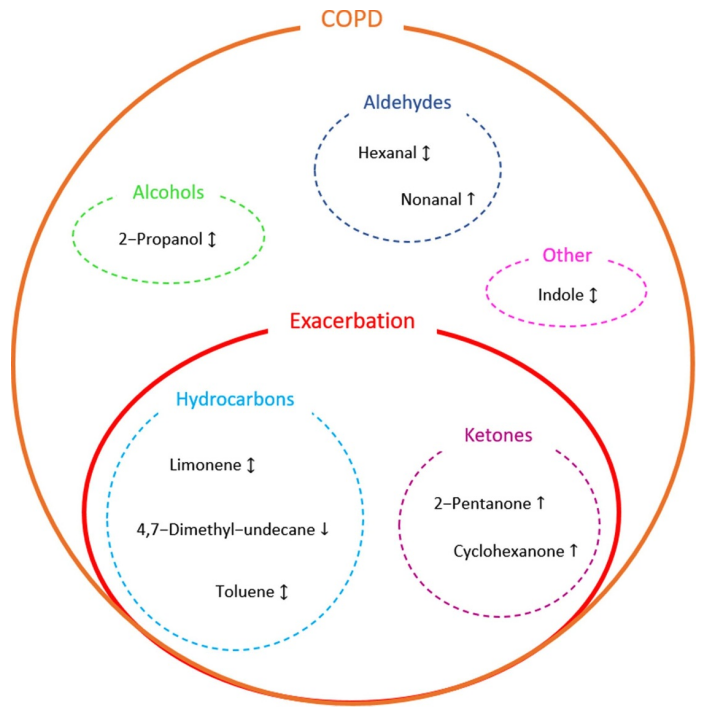
Overview of the selected candidate exhaled biomarkers extracted from the literature, grouped by molecular class.
Relative intensities of the VOCs enclosed by the COPD circle (orange) are compared to healthy controls (COPD vs healthy). Relative intensities of the VOCs enclosed by the Exacerbation circle (red) are compared to stable COPD (exacerbation vs stable COPD). ↑: upregulated; ↓: downregulated; ↕: inconclusive findings; COPD; VOC.
Copied from van Poelgeest et al. (2025).
The importance of validation
The field of breathomics has generated significant excitement in recent years, but translating discoveries into clinical implementation is no simple feat and requires rigorous validation.
Many studies identify potential biomarkers, yet only a few demonstrate that these biomarkers remain meaningful when tested across different datasets and patient populations. Our study addresses that challenge directly: by combining evidence from multiple independent studies with validation in longitudinal patient samples, the researchers provide stronger evidence that specific VOC patterns are genuinely associated with COPD exacerbations, rather than being confined to isolated experimental findings.
That distinction is essential for developing clinically useful monitoring technologies.
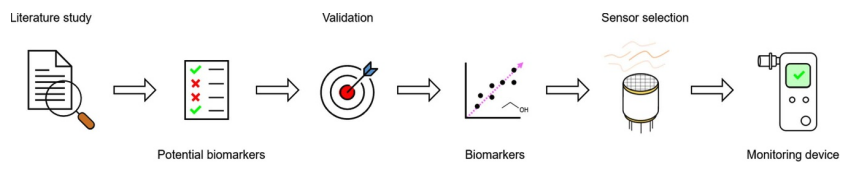
Overview of the steps required to develop an exhaled breath-based disease stability monitoring device.
Copied from van Poelgeest et al. (2025).
Moving from reactive to proactive care
The work published by van Poelgeest and colleagues has a great clinical value that extends beyond biomarker discovery, hinting at a future in which COPD management becomes increasingly proactive rather than simply reactive.
Research has shown that the biological and symptomatic changes associated with COPD exacerbations often begin days and sometimes weeks before patients seek treatment (1,2). This evidence presents an important opportunity: if these early changes can be reliably detected, clinicians may be able to intervene before a full exacerbation develops. Tracking exhaled breath biomarkers may offer a direct window into the inflammatory and metabolic processes occurring in the lungs, allowing for the detection of disease activity as it emerges.
This goal is ambitious, yet increasingly realistic and could, in turn, enable earlier treatment decisions, reduce hospitalisations, and improve long-term outcomes for people living with COPD.
From biomarker discovery to real-world monitoring
Identifying reliable biomarkers is only the first step. The ultimate challenge is translating these scientific discoveries into tools that can support patients and clinicians in everyday care. To address this challenge, RespiQ is actively involved in clinical research programs designed to validate breath-based monitoring technologies in real-world settings.
Through collaborations with Amsterdam UMC and participation in the EIC Pathfinder Breath-Sense project, together with partners including King's College London, Leiden University Medical Center, and others, we are working to advance non-invasive breath analysis for early prediction and monitoring of COPD exacerbations.
These efforts reflect a broader shift in respiratory care: moving from episodic assessment toward continuous, patient-centred monitoring. By combining validated biomarkers with practical sensing technologies, the aim is to provide clinicians with actionable insights earlier in the disease pathway—when interventions have the greatest potential impact.
While further prospective studies remain essential, every clinical trial brings us closer to a future where a simple breath measurement can help identify deterioration earlier, support personalised treatment decisions, and improve outcomes for people living with COPD.
Building the next generation of respiratory monitoring
At RespiQ, we believe the future of respiratory care lies in transforming biological insights into practical tools that support patients and clinicians in everyday life.
Studies like the one summarised here demonstrate why breath analysis continues to attract attention as a non-invasive monitoring approach: Breath sampling is simple, repeatable, patient-friendly, and uniquely positioned to capture real-time information about respiratory health.
While further prospective studies are still needed, the validation of these COPD-associated VOC biomarkers represents another important step toward making breath-based monitoring a clinical reality. The goal is to detect change earlier, enable timely intervention, and help patients stay healthier for longer. Mounting evidence suggests that the answer may already be right in front of us—in every breath we take.
About the Study
van Poelgeest J, Shahbazi Khamas S, Hallawa A, D'Alessandro C, Ferreira R, Maitland-van der Zee AH, Brinkman P. Exhaled volatile organic compounds associated with chronic obstructive pulmonary disease exacerbations—a systematic review and validation. Journal of Breath Research 19:026008 (2025). doi: https://doi.org/10.1088/1752-7163/adba06
The study combined a systematic review of published COPD breath biomarker research with validation using longitudinal breath samples from COPD patients collected during stable disease, exacerbation, and recovery phases. The resulting six-biomarker model achieved 94.3% diagnostic accuracy for distinguishing exacerbations from stable disease.
References
van den Berge M, Hop WC, van der Molen T, et al. Prediction and course of symptoms and lung function around an exacerbation in chronic obstructive pulmonary disease. Respir Res 13(1), 44(2012). doi: https://doi.org/10.1186/1465-9921-13-44.
Watz H., Tetzlaff K., Magnussen H. et al. Spirometric changes during exacerbations of COPD: a post hoc analysis of the WISDOM trial. Respir Res19, 251 (2018). https://doi.org/10.1186/s12931-018-0944-3
Written by Laura Verga, 25/06/2026
Reviewed by Mira Gleisberg, 23/06/2026
